Alvin Cheng-Hsien Chen 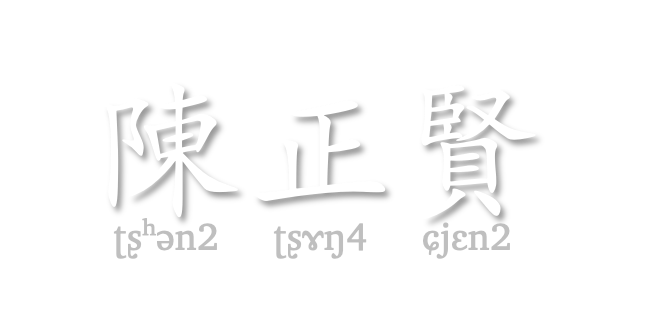
Welcome to Alvin Chen's homepage.
“If you want to run, run a mile. If you want to experience a different life, run a marathon.”– Emil Zátopek
Welcome to Alvin Chen's homepage.
“If you want to run, run a mile. If you want to experience a different life, run a marathon.”– Emil Zátopek

I am a corpus linguist, teaching at the Department of English, National Taiwan Normal University, Taiwan, where I am a full-time faculty member in the Linguistics track.
My journey into linguistics began a long time ago during my Pronunciation Class as a freshman in college. I was fascinated by the systematic organization of sounds and their application to learning human speech sounds. This novel perspective inspired me to pursue linguistic studies further, thanks in large part to my mentor, Cherry Li!
Currently, my work extends beyond traditional linguistics. Most of my research focuses on the methodology of quantitative corpus linguistics. I am particularly interested in the interrelationship between language, interaction, and cognition. A longstanding question that I have been exploring is how repeated or recurrent language use motivates the emergence of systematic linguistic structures. Furthermore, I investigate how this usage-based view of language connects to computational modeling of language processing, language acquisition and learning, and the mental representation of speakers.
I have published corpus-based research in several academic journals, such as Corpus Linguistics and Linguistic Theory, Cognitive Linguistics, Journal of Phonetics, Language Learning, System, Language and Speech and continue to be active in research on quantitative approaches to language processing.
I am currently an associate editor for Language and Linguistics and a member of the editorial board for Corpus Linguistics and Linguistic Theory and Amparsand. Previously, I served as a co-editor of Concentric: Studies in Linguistics from 2024 to 2025.
Over the past few decades, corpus linguistics has undergone a paradigm shift toward quantitative and computational approaches. Navigating this transition has been challenging yet rewarding. In recent years, the rapid advancement of artificial intelligence, particularly large language models, has transformed both the methodology of linguistic data analysis and the theoretical conceptualization of language itself. These developments offer new opportunities for modeling usage patterns, simulating language learning, and testing cognitive hypotheses at scale. Furthermore, they prompt researchers to re-examine traditional assumptions regarding linguistic competence and performance.
And, I am a fan of and , the two artificial languages that have revolutionized the way we process human languages .
Finally, a few things I like to do if I have free time: , , , , .
PhD in Computational Linguistics, 2006-2012
National Taiwan University & Academia Sinica (TGIP-CLCLP)
MA in Linguistics, 2003-2006
National Taiwan University
BA in English, 1999-2003
National Taiwan Normal University
80%
80%
40%
40%
40%
40%
20%
Funded by Taiwan Ministry of Science and Technology